Staying With the Trouble (group show) | Cullity Gallery | [2026]
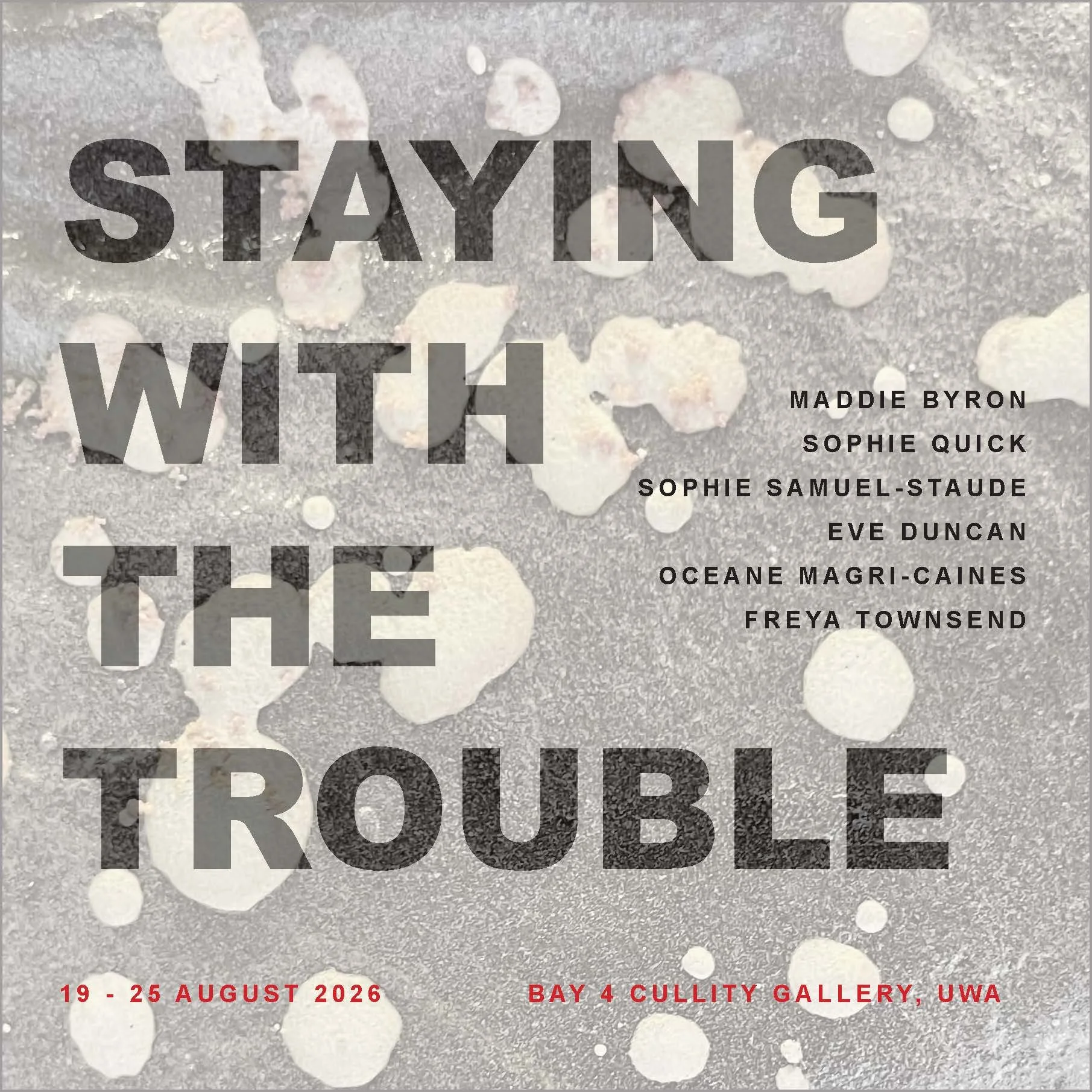
Curatorial Statement
When facing environmental crises, we face crises of care.
Staying with the Trouble is created within a time known as the Anthropocene, summarised as “…the first time a single species has caused such destructive effects on the natural world and had an awareness of doing so.”¹
Ecological grief arises due to the potential loss of species inherently connected with the Australian psyche and national rituals. This centres grief as a potential loss of self. Although the grief and heaviness of the Anthropocene gives reason to cower, Staying with the Trouble becomes a necessity.
In her 2016 book, Staying with the Trouble: Making Kin in the Chthulucene, post-humanist writer Donna Haraway acknowledges the entanglement of the human race with the natural world around us.² She reflects on the symbiosis of human and non-human species to each other and with the landscape at large. Importantly, Haraway urges us to acknowledge and engage with our planet as it is today rather than fracture into blind optimism or “paralysing pessimism”. Haraway’s thinking foregrounds conversations continued within the exhibition, Staying with the Trouble.
Staying with the Trouble celebrates the wonder and awe inspired by the natural world around us while acknowledging the angst and fear of losing its fragile balance. The works explore channels of communication between species and how humans might learn to better understand this planet and its intricate and often unseen mechanisms. These problems place us as citizens of our planet that transcends political borders.
Reflecting individual interpretations of Staying with the Trouble, a connected dialogue between works investigates ecological grief and resilience through inter-species communication, monitoring and acceptance. Maddi Byron considers endemic and introduced flora and fauna through the fusion of glass, symbolic of colonised ecosystems. Co-creating with black cockatoos, Sophie Samuel-Staude explores interspecies communication as a vessel for empathy, giving visual form to endangered voices. Sophie Quick animates wild birds as the canary-in-the-coal-mine of our natural environment, a way to monitor our own successes or failures as we grapple with potential loss of a national icon. The duality between the strength and fragility of the natural world is explored through Eve Duncan’s repetitive pattern-making and mapping. Oceane Magri-Cairnes uses found materials to sculpt a location with perceived beauty and complicated reality. These contemplations of resilience and fragility are contrasted with Freya Townsend’s speculative and artificial imitation of nature.
Together, the works of Staying with the Trouble ask visitors how one might grapple with the enormity of caring for our planet in its contemporary and fragile form. How we might engage in multi-species conversations and remember the entanglement between human and non-human, with intent for reciprocal futures. And how we might exist with a pendulum that swings earnestly between a paralysing sense of doom and the belief that daily acts of care are making a difference.
Offering guidance, Donna Haraway’s expression, “learning to stay with the trouble of living and dying together on a damaged earth”³ urges us all to continue to converse, question and create in troubled times, leading with care and curiosity.
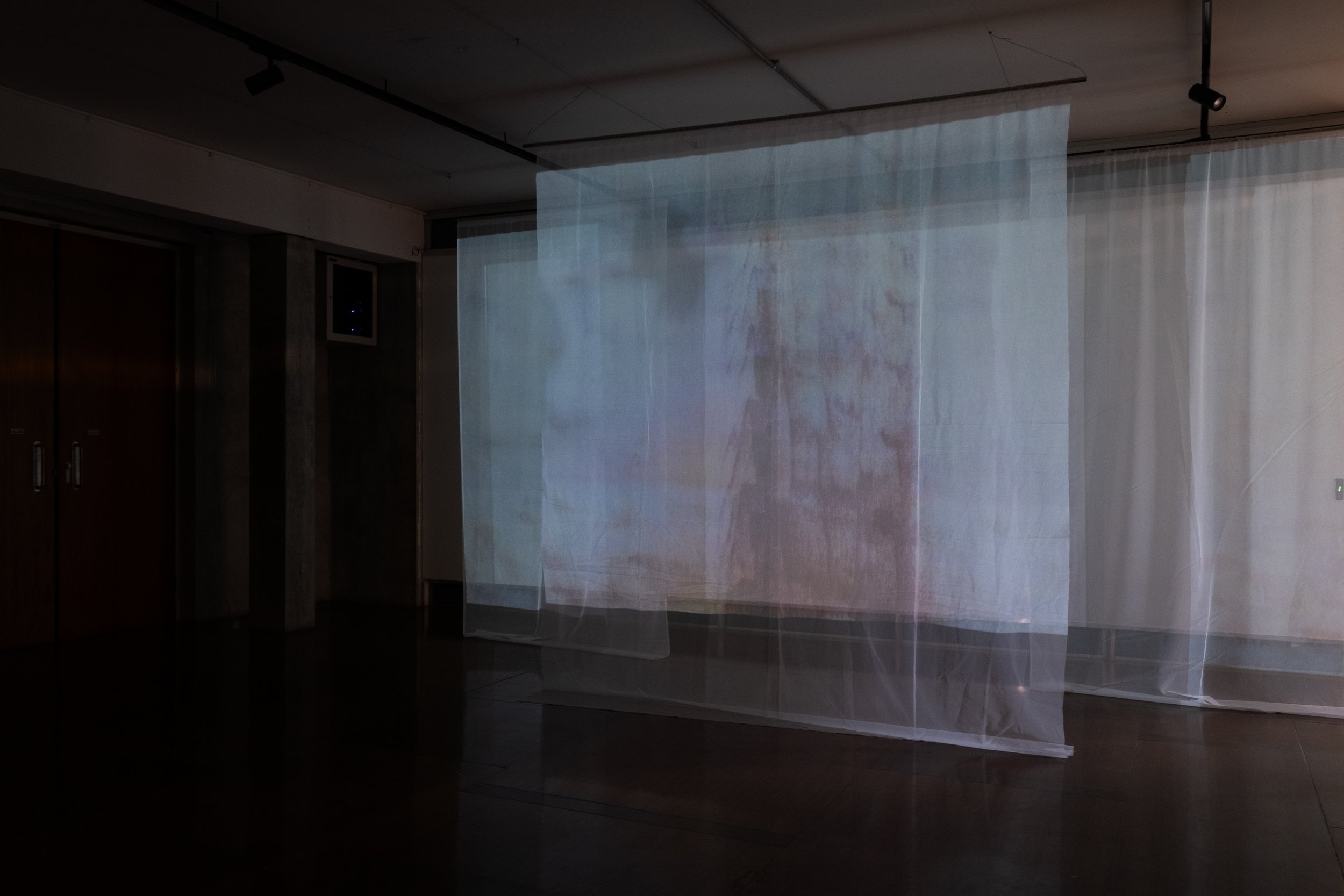
Their voices inscribe marks into time and space in Staying With the Trouble (group show)| Cullity Gallery | [2026]
1. Pavid, Katie. 2024. “What Is the Anthropocene and Why Does It Matter?” Natural History Museum. 2024. https://www.nhm.ac.uk/discover/what-is-the-anthropocene.html.
2. Haraway, Donna Jeanne. “Staying with the Trouble : Making Kin in the Chthulucene.” Duke University Press, 2016. https://doi.org/10.1515/9780822373780.
3. Haraway, Donna Jeanne. “Staying with the Trouble : Making Kin in the Chthulucene.” Duke University Press, 2016. https://doi.org/10.1515/9780822373780.